The Story Behind Gotta Play Games and Skip the Salad
Skip the Salad started as a Friday-night game with our eight kids and grew into a real card game with a real reason. Here's the story, from the kitchen table to a Polish print shop.

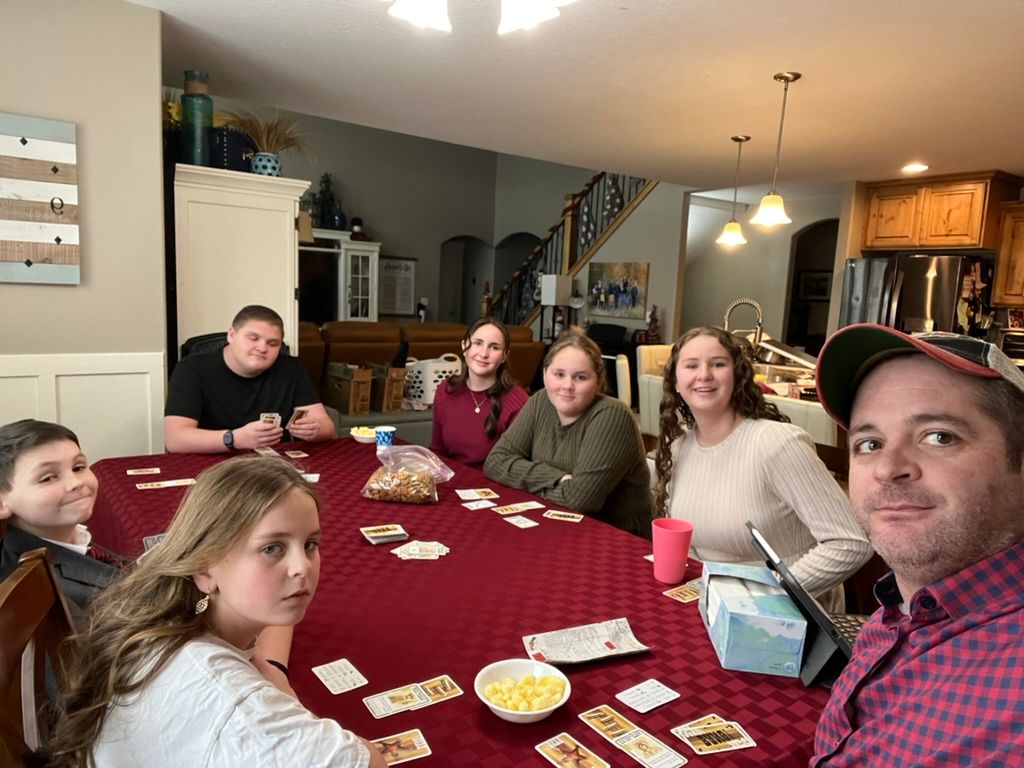
We're a family of ten. Eight kids, two parents, every age and every interest you can imagine, and the only thing that reliably brought all of us into the same room without phones in our hands was a deck of cards.
That's the short version of why Skip the Salad exists. The longer version is more interesting.
Friday-night games as the family operating system
For a long time before there was a company, there was just Friday night and Sunday afternoon. Card games on road trips. Board games after dinner. Strategy games that turned into weekend-long rivalries. The thing we noticed (and didn't really name for years) was that games leveled the playing field in our family in a way nothing else did.
Several of our kids are neurodivergent. Two of our sons are on the autism spectrum. We've spent years navigating diagnoses, school systems, IEPs, and the daily reality of raising kids whose minds work a little differently than the world expects. Most weeks, that comes with friction. The kind of small daily friction that makes connection harder, not impossible, but harder.
But at the table? Different rules apply. The mechanics treat everyone the same. The dice don't care how your brain works. A trick is a trick. The youngest kid can sweep the oldest. Some of our kids who struggle to make eye contact during dinner conversation will trash-talk their siblings for five straight minutes over a card game and not stop smiling.
That insight, that the game table is one of the few places where everyone in our family meets each other on equal footing, is the seed of everything else.
How Skip the Salad came together
The real seed of Skip the Salad is a card game my brother taught us called Canadian Salad, which is played with face cards. It's a multi-round trick-avoidance game where every round changes what you're trying to avoid, and the lowest score after all the rounds wins.
When we decided to make our own card game, Canadian Salad was the starting point because, as fun as it is, there is room for improvement on the gameplay and rules. We loved its core shape: multiple rounds, a different penalty rule each round, standings that can flip in the last hand. We wanted to keep that and add more. More rounds we could mix in. Optional strategic layers that change the flavor of every game. A theme that doesn't require any prior card-game context.
Hearts is great if you grew up with it, but "the Queen of Spades is bad, and the Three of Clubs leads" is a lot to hand a 9-year-old. "Don't take the King of Onions" is something a 7-year-old gets in one round.
So we made a card game where the suits are vegetables. There were vegetables that clearly aligned with traditional suit symbols (broccoli for spades, tomatoes for hearts, etc). The penalty cards are different things you might not want at your table: too many tomatoes, the King of Onions, a pile of queens. The "advanced" cards are Toppings you mix in to make every round feel different. There's a Rotten Tomato that gets passed around. A Cornucopia that flips the whole game so collecting points is suddenly good. A Spicy Pepper that introduces trump and lets the player in last place choose which suit gets to bully everyone else.
Six rounds. The whole thing takes 20 to 40 minutes (partially depending on if you are playing with family members who have ADHD 😜). Lowest score wins.
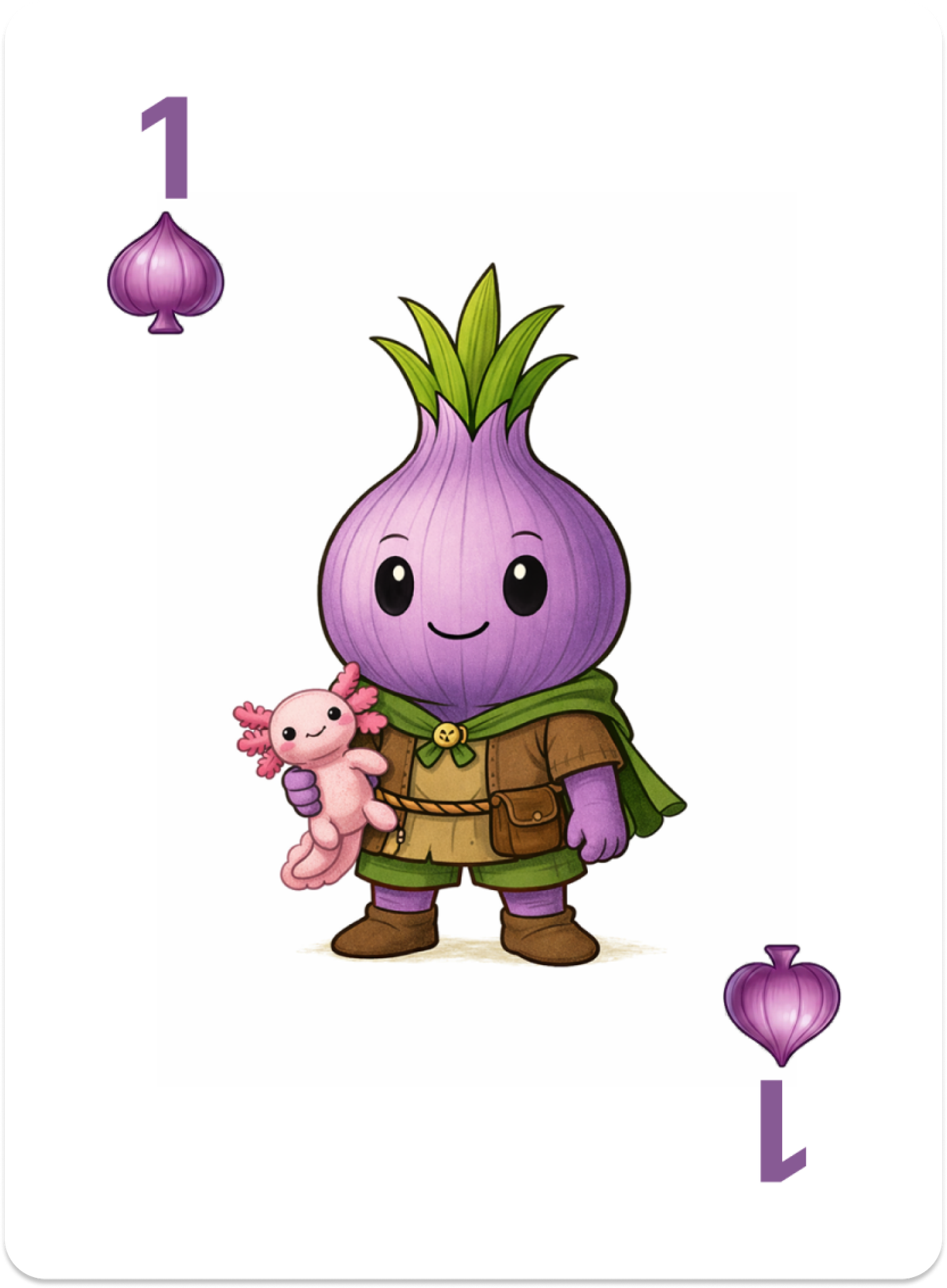
We've now played hundreds of games of it. The whole family chipped in with ideas. The one of Onions is holding a stuffed axolotl because my youngest, Tayson, thought it would be hilarious. Parker, who has a knack for finding loopholes in technology, has become an excellent QA resource for testing the mobile app. McKinley has weighed in on rule changes. We even pulled the game out when we went to Disneyland for spring break to play as a family.
The harder reason we built this
We could have stopped at "we made a card game we love." We didn't, because of a number that sat with us.
Research from Drexel University's Life Course Outcomes study found that four in every 10 young adults on the autism spectrum never worked for pay between high school and their early 20s. That's the lowest employment rate of any disability group studied. More than one in three are completely disconnected from both work and education.
Two of our sons sit somewhere in that statistic. They're capable, they want to work, and the path between "high school graduation" and "meaningful job" is narrower for them than it is for their neurotypical siblings. We didn't want to just feel that. We wanted to do something about it.
So we started Gotta Play Games LLC and hired our sons. They have real responsibilities: illustration review, packaging fulfillment, app testing, social content, and some project management. They earn a paycheck. They build experience. The game you're playing was, in part, made by them.
That's why every box has a small badge on it acknowledging our support of the neurodiversity community. It's not a marketing decision. It's the actual reason the company exists.
Where the game gets made
Skip the Salad is printed in Poland by Fabryka Kart, a card-game manufacturer that makes some of our favorite indie family games, including the Grandpa Beck Games line, which we'd been quietly admiring for years before we knew we'd be working with the same shop.
We made that choice deliberately. Cardstock matters. The shuffle feel matters. Fabryka has a reputation for quality card production, and we wanted the physical thing in your hands to feel like something worth keeping. When my brother found out we were making a game, the first thing he said was, “Please make sure it has high-quality materials.” Even though this is our first game, we decided to go the extra mile, so we hope you enjoy the linen finish and the black core cards (if you don’t know what that means, don’t worry; neither did we until a month ago).
Using AI in the process
At the outset of this project, we faced a difficult decision: how much should we rely on AI in creating this game?
Part of our motivation was to teach our boys. AI will be a part of their future, for better or worse, so it felt important to include it in our process. At the same time, I have friends who are authors, artists, and musicians, and I understand the very real concerns about what AI could mean for their work.
In the end, we made the admittedly controversial decision to make AI a significant part of our process. Quite simply, we could not afford to hire an artist to design over 100 cards. AI also enabled our twins to contribute in ways they otherwise could not, helping with the website and app through what is often called “vibe coding.”
We used AI as a tool to bring our creative vision to life. It helped generate card art, build the website and app, refine the rules, manage project tasks, and navigate the steps of starting a business. What might have taken a year was compressed into just a few months.
That said, AI did not create Skip the Salad. We have invested hundreds of hours designing, debating, and executing on the vision. Blood, sweat, and tears have gone into its creation.
I know some in the gaming community will choose not to support this project because of AI’s involvement. I understand that perspective, and I respect it.
But for me, this project is about more than just a game. It is about building confidence and experience in my boys. It is about creating something that brings families together, whether around a table or across the country through an app.
This product exists because AI, used as a tool, made it possible.
What we're really making
Friday nights, basically.
The phones-down (unless you are using the mobile app), sit-down, lose-your-mind-laughing-because-someone-just-took-the-King-of-Onions-on-the-last-trick kind of Friday night. That's the thing we want to put in your house, your friend group's living room, your family's vacation rental.
We made a card game. The reason it exists is the moment after the cards land, when somebody at your table is groaning, somebody else is celebrating, and everybody's already arguing about what to play next.
If you're new here: welcome to the family. Gather up. Game on.
Brandon
Skip the Salad should be available on iOS and Android by the end of May, with the physical card game launching July 2, 2026. Learn more about Skip the Salad.